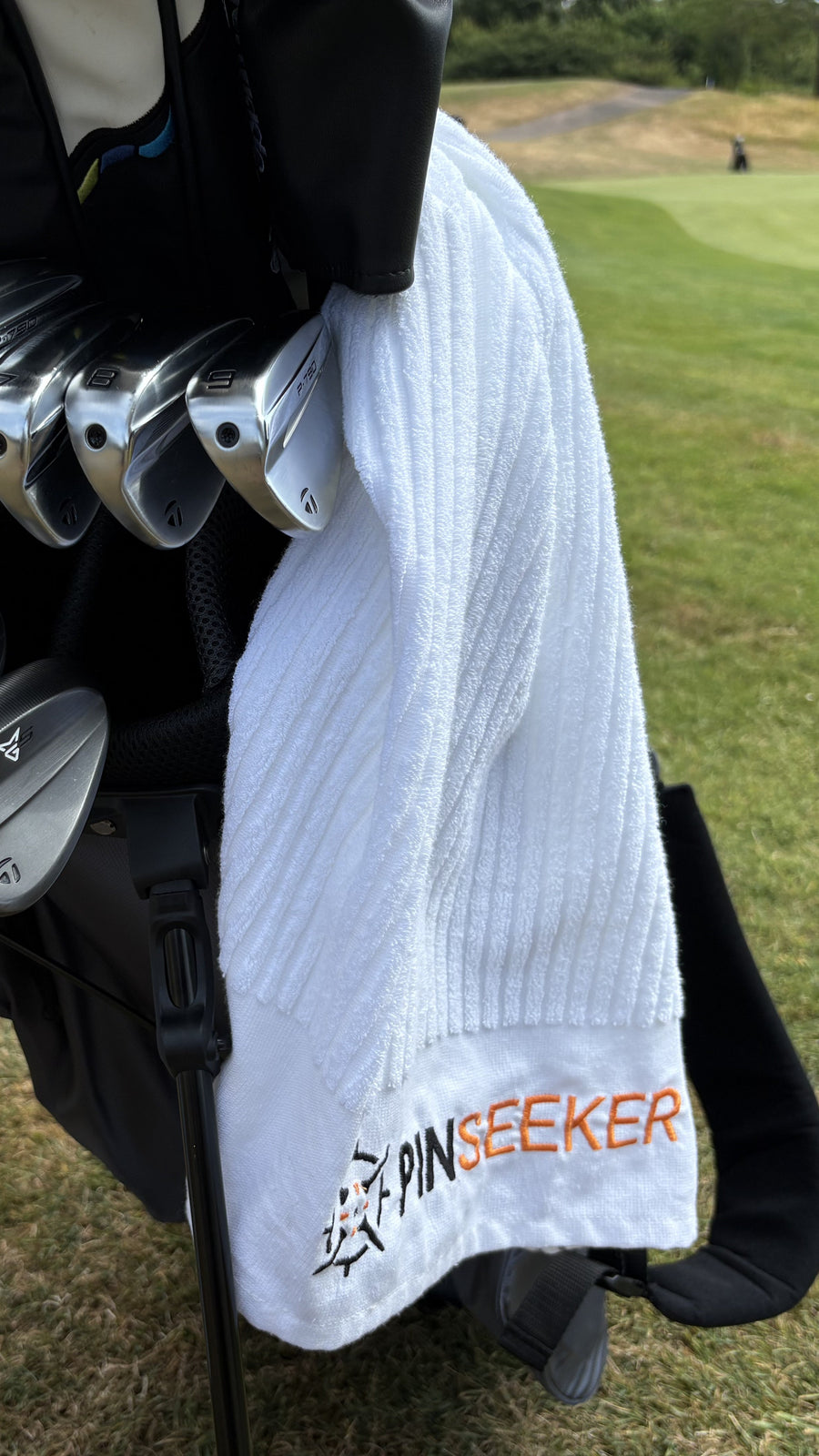
Cotton golf towels absorb more moisture per wipe than microfibre equivalents in wet conditions, hold that moisture in the fibre body rather than releasing it on the next contact, and provide the full-length coverage needed to maintain a wet zone and a dry zone across an entire round. On a wet course, cotton outperforms microfibre in the specific conditions where you need a towel most. The tradeoff is weight and drying speed, both of which matter more on a walking bag in summer than on a buggy round in autumn.
What Makes Cotton Different from Microfibre?
Cotton fibres are naturally hollow tubes. Moisture is drawn into the hollow core of each fibre by capillary action and held there until the fibre can no longer absorb more. At 550GSM, the fabric has dense fibre packing: more fibres per square centimetre, more fibre core volume, more total moisture held per wipe.
Microfibre works differently. The filaments are split during manufacture into dozens of micro-strands, each of which holds moisture on its outer surface rather than internally. The total surface area of those filaments is enormous, which makes microfibre fast and efficient at lifting dry debris. In heavy rain, however, the surface-held moisture releases more readily on the next contact point than moisture held inside a cotton fibre.
For a wet round where the towel is managing mud, water, and grass simultaneously, the internal-hold mechanism of cotton keeps the wet zone wetter for longer and the dry zone drier for longer.
Cotton's moisture retention comes with a slower recovery time. After a full wipe, a cotton fibre takes longer to release excess surface moisture than a microfibre filament. This is why cotton towels feel heavier and slightly damper to the touch during use compared to microfibre of similar surface area. For on-course use across a full round, this is not a practical problem: you use the wet zone for cleaning and the dry zone for finishing, not cycling the same section repeatedly. The two-zone method accounts for cotton's slower drying behaviour.
Absorbency in Wet Conditions
In moderate conditions, both cotton and microfibre perform adequately. The performance gap opens in sustained rain.
A microfibre towel at 400GSM can approach saturation in both active sections by the back nine on a heavy day. At 550GSM cotton with a 55x105cm surface, the total absorption capacity is significantly higher: more fibre volume spread across a larger area. The cotton wet zone holds more water from more wipes before it becomes ineffective.
On a wet round, a cotton towel's absorbency advantage compounds across 18 holes. A microfibre towel that is nearly saturated at the 14th hole cleans less effectively on every shot from that point forward.
Why Full Length Matters
A full-length caddy towel at 55x105cm gives you more working surface than mid-length alternatives. That surface is not just about total capacity: it is about how much of the towel you can keep genuinely dry.
Both halves of the towel are in use through the round. The wet section picks up mud and grass and transfers some moisture to the dry section on the handover. A longer towel has more total dry section to draw from as the round progresses. By the time you reach the closing holes, a full-length towel still has dry material available.
Cotton in Cold and Wet Conditions
Cotton holds warmth better than microfibre, which is one reason the caddy format suits early morning and autumn rounds. On a cold course where you are also wiping your hands between shots, a cotton towel provides more comfort on contact than a thin microfibre equivalent.
The 550GSM weight also gives the towel enough body to serve as a grip warm, a hand dry, and a club wipe without the towel feeling flimsy in cold hands.
How Cotton Golf Towels Age
Cotton golf towels become more absorbent with repeated washing, not less, provided you avoid fabric softener. The cotton fibres soften and open slightly with each wash cycle, increasing their absorption rate. A 550GSM cotton towel used across a full season washes and performs better at round 100 than at round one.
Fabric softener reverses this: the softener deposits a coating across the fibre surface that seals the absorption mechanism, just as it does in microfibre. For both cotton and microfibre, no softener is the standing rule.
For washing guidance that preserves absorbency across both cotton and microfibre towels, see how to wash a golf towel and keep it absorbent. For a full comparison of caddy and tour formats across conditions and bag setups, see caddy golf towel vs tour golf towel.