The best golf cap stays put through a full swing, moves heat out on a warm afternoon and sheds a shower without soaking through. That comes down to six things you can check before you buy: fit, venting, weather resistance, panel construction, brim and care. Price matters less than whether the cap does those six jobs.
What separates a good golf cap from a bad one?
Most golf caps look the same on a shelf. The differences show up on the course: a crown that creases in wind, a sweatband that stains by June, a brim that flops in rain. Use the table as a checklist. If a cap fails two rows, it is not the best golf cap for you.
| Criteria | What to look for |
|---|---|
| Fit | An adjustable snapback closure that holds one setting all round, with a moisture-wicking liner behind the band |
| Venting | Laser-perforated panels rather than open mesh, so heat escapes without the crown letting rain straight in |
| Weather resistance | A water-repellent DWR shell for showers and drizzle; a sealed membrane only if you play in sustained heavy rain |
| Panel construction | A structured five-panel crown with a single front panel, so there is no centre seam and the front holds its shape |
| Brim | Pre-curved and reinforced, wide enough to shade the eyes at address, stiff enough to survive the bag |
| Care | Hand wash in cool water, air dry on a shape, no tumble dryer and no fabric softener on a DWR shell |
How should a golf cap fit?
A golf cap should sit level on the head, brim just above the eyebrows, with enough grip at the back that a full driver swing does not shift it. Fitted caps come in fixed sizes and loosen as the fabric relaxes. An adjustable snapback lets you set the circumference once, then leaves it alone.
The second part of fit is the liner. Look for a moisture-wicking band inside the crown. It keeps sweat off your forehead on a warm back nine and stops the salt line that turns a white cap grey by midsummer. One size fits most is fine as long as the closure has range for a beanie underneath in November.
Why does venting matter on a golf cap?
A round takes four hours, most of it walking. Without venting, heat builds inside the crown and the cap becomes the thing you notice instead of the shot. There are two ways to vent a cap. Open mesh panels move the most air but let rain straight through and lose structure over time. Laser-perforated venting cuts small holes in the shell itself, so air moves out through the panel while the fabric keeps its shape and its weather resistance.
For UK golf, laser perforation is the better trade. You get airflow in July without giving up the shell in October.
Do you need a waterproof golf hat?
For most rounds, no. A water-resistant cap with a water-repellent DWR shell handles drizzle, light showers and variable weather, which is the majority of UK golf. A fully waterproof golf hat uses a laminated membrane and sealed seams. It blocks water completely but breathes less and costs more.
A waterproof golf hat earns its place if you regularly play through sustained heavy rain or winter rounds where the cap never dries. If you check the forecast and skip the worst of it, water-resistant is sufficient. We explain the membrane-versus-coating difference, and when each one is worth paying for, in our guide to waterproof vs water-resistant golf caps.
On a course in Surrey in April, with showers passing through every 40 minutes, a DWR cap was still beading water on the 15th tee. The brim shed it clear of the eyes on every downswing. What ran out was the liner, not the shell: by the 17th the band was damp and the cap felt heavier than it looked. A second cap in the bag for the back nine would have fixed it.
Does panel construction change how a cap plays?
Yes, and it is the criterion most buyers skip. A six-panel cap has a seam running down the centre of the front. A five-panel cap uses one wide front panel instead. That single panel holds a structured shape better, gives a clean line at address and does not pinch at the seam when the cap is wet.
Structured means there is a stiffener behind the front panel so the crown keeps its profile on your head or in the bag. Unstructured caps pack smaller but crease in wind and collapse at the front once the fabric softens. For a cap you will pull on before every round, structured five-panel is the construction to look for.
A cap that loosens on the tee, drips on the green and creases by the turn is not a golf cap. It is a hat you happened to wear to golf.
What should the brim do?
The brim has three jobs: shade the eyes when the sun is low, shed rain clear of the face, and survive being thrown in a bag. A pre-curved brim does the first two. Reinforcement does the third. Flat brims funnel rain onto your nose and do nothing for a low sun on the 18th. A mid-width curved brim is the practical choice.
How do you care for a golf cap?
Hand wash in cool water with a mild detergent, rinse, and air dry on a shape such as a bowl. Do not machine wash a structured cap: the agitation breaks down the stiffener and a tumble dryer shrinks the crown. Never use fabric softener on a DWR shell. It coats the fibres and stops rain beading, which undoes the weather resistance you paid for.
If the shell stops beading after a season, a spray-on DWR treatment restores it. Sweat marks on the liner come out with a soft brush and a little detergent before rinsing.
Which golf cap do we recommend?
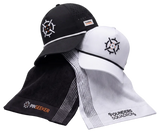
The PINSEEKER Performance Golf Cap is built to the six criteria above: a structured five-panel crown, laser-perforated venting, a water-repellent DWR shell that beads rain, a reinforced pre-curved brim and an adjustable snapback with a moisture-wicking liner. It sheds showers and drizzle; a sustained downpour is its limit. It comes in Blackout and Whiteout at £18.99, with a 12-month guarantee covering manufacturing defects.
If the field note above rang true, the Wingman Bundle pairs two caps at £29.99, so there is a dry one in the bag for the back nine. Both colourways are in the Performance Caps collection.
Frequently Asked Questions
What is the best golf cap for hot weather?
A light structured cap with laser-perforated venting and a moisture-wicking liner. The perforations move heat out of the crown, the liner keeps sweat off your forehead, and a curved brim shades the eyes. Whiteout colourways reflect more sun than dark ones. Open mesh vents more but gives up shape and weather resistance.
Is a snapback golf cap better than a fitted one?
For most golfers, yes. A snapback sets to one circumference and holds it through a full swing, then adjusts when you add a beanie in winter. A fitted cap relies on the fabric staying taut, which it does not after a season of wear and rain. One snapback replaces several fitted sizes.
Do I need a waterproof golf hat in the UK?
Only if you regularly play through sustained heavy rain. A water-resistant DWR cap beads showers and drizzle, which covers most rounds, and breathes better than a sealed membrane. Waterproof caps cost more and run warmer. Read the forecast: if you skip the worst days, water-resistant is enough.
How long should a golf cap last?
A structured cap with a reinforced brim should give you a full season of regular play, and often two, if you hand wash it and air dry it on a shape. The liner and the DWR coating wear first. A spray-on treatment restores the shell; a soft brush and cool water restore the band.
Does a five-panel cap fit differently from a six-panel?
Slightly. The single front panel on a five-panel cap sits flatter across the forehead, with no centre seam to pinch when the cap is wet. The crown profile is cleaner at address and holds its shape better in wind. Circumference is set by the closure either way, so the size range is the same.
Why do golfers wear caps?
A curved brim shades your eyes and cuts glare when the sun is low, which helps you read the line and track the ball. A wicking band keeps sweat off your face through a long round. In rain, the brim sheds water away from your eyes, so you can keep your focus on the shot.