A waffle weave golf towel uses a grid-pattern fabric structure with raised squares and recessed channels between them. The raised squares make contact with the clubface; the channels act as collection points, pulling moisture and debris away from the contact surface with each wipe. The result is a towel that cleans by lifting rather than smearing, which matters significantly for groove performance across a full round.
How Waffle Weave Works
The weave creates a three-dimensional surface: a repeating pattern of raised squares and sunken channels. When you wipe a clubface, the raised squares apply pressure and the recessed channels draw grass particles, mud, and moisture into the body of the towel rather than pushing them across the face.
A flat-weave or terry cloth towel does not have this channel structure. It applies pressure evenly across the face, which cleans surface grime but is less effective at drawing debris out of the narrow groove channels in your irons and wedges.
The cleaning efficiency of a waffle weave comes from the ratio of raised surface to channel depth. A shallow waffle with small channels picks up less debris per wipe than a deep waffle with well-defined channels. In microfibre construction, the split filaments within each thread compound this effect: each filament is a microscopic hook that traps particles independently. A 400GSM waffle microfibre towel has both the structural channels of the weave and the mechanical grip of split-fibre microfibre working simultaneously.
Waffle Weave vs Terry Cloth: What Is the Difference?
Terry cloth uses a looped pile construction: thousands of small loops standing upright from a flat base. The loops are soft and highly absorbent, which makes terry cloth effective for drying hands and absorbing bulk moisture. The loops are also relatively large and soft, which means they flex under pressure rather than applying concentrated scrubbing action to groove edges.
Waffle weave has a shorter, denser structure with firm edges on the raised squares. That firmness means more pressure per contact point at the same wiping force, which is why waffle weave cleans faster and requires fewer passes across a groove to clear compacted debris.
| Feature | Waffle Weave | Terry Cloth |
|---|---|---|
| Cleaning action | Lifts debris via channels | Absorbs bulk moisture |
| Groove cleaning efficiency | Higher | Lower |
| Drying speed | Faster (channel airflow) | Slower (looped pile traps moisture) |
| Surface texture | Firmer | Softer |
| Best for | Club cleaning mid-round | Bulk drying and hand comfort |
Why Waffle Weave Matters for Groove Cleaning
The grooves on irons and wedges generate backspin at impact by engaging the cover of the golf ball at a microscopic level. When those grooves are clogged with grass or mud, the engagement is disrupted and backspin drops. That drop bites hardest on a wedge from a wet or grassy lie, where the grooves have moisture to clear before they can grip, the difference between an approach that pitches and stops and one that pitches and releases.
A waffle weave towel clears compacted groove debris more efficiently than flat-weave alternatives of the same GSM. On a wet course, where clubs pick up mud and grass on every iron shot, this efficiency compounds across 18 holes.
The channel structure of a waffle weave is the difference between a wipe that cleans and a wipe that redistributes. For scoring clubs, that distinction matters on every approach shot from 100 yards in.
Waffle Weave and Drying Speed
The channels between the raised squares allow airflow through the towel, which is why waffle weave dries faster between wipes than terry cloth. On a dry round, this means the damp section of the towel recovers faster. On a wet round, it means the towel is less likely to become fully saturated by the back nine.
The quicker drying speed also preserves the dry side. A waffle towel that has been used to clean a wet club dries its surface faster between uses, so the finishing zone stays genuinely dry for longer.
GSM and Waffle Weave Combined
A waffle weave structure at low GSM (200-300GSM) will lose the depth of its channels faster as the towel absorbs moisture. At 400GSM, the fabric body is dense enough to support the channel structure through a full round without the weave flattening.
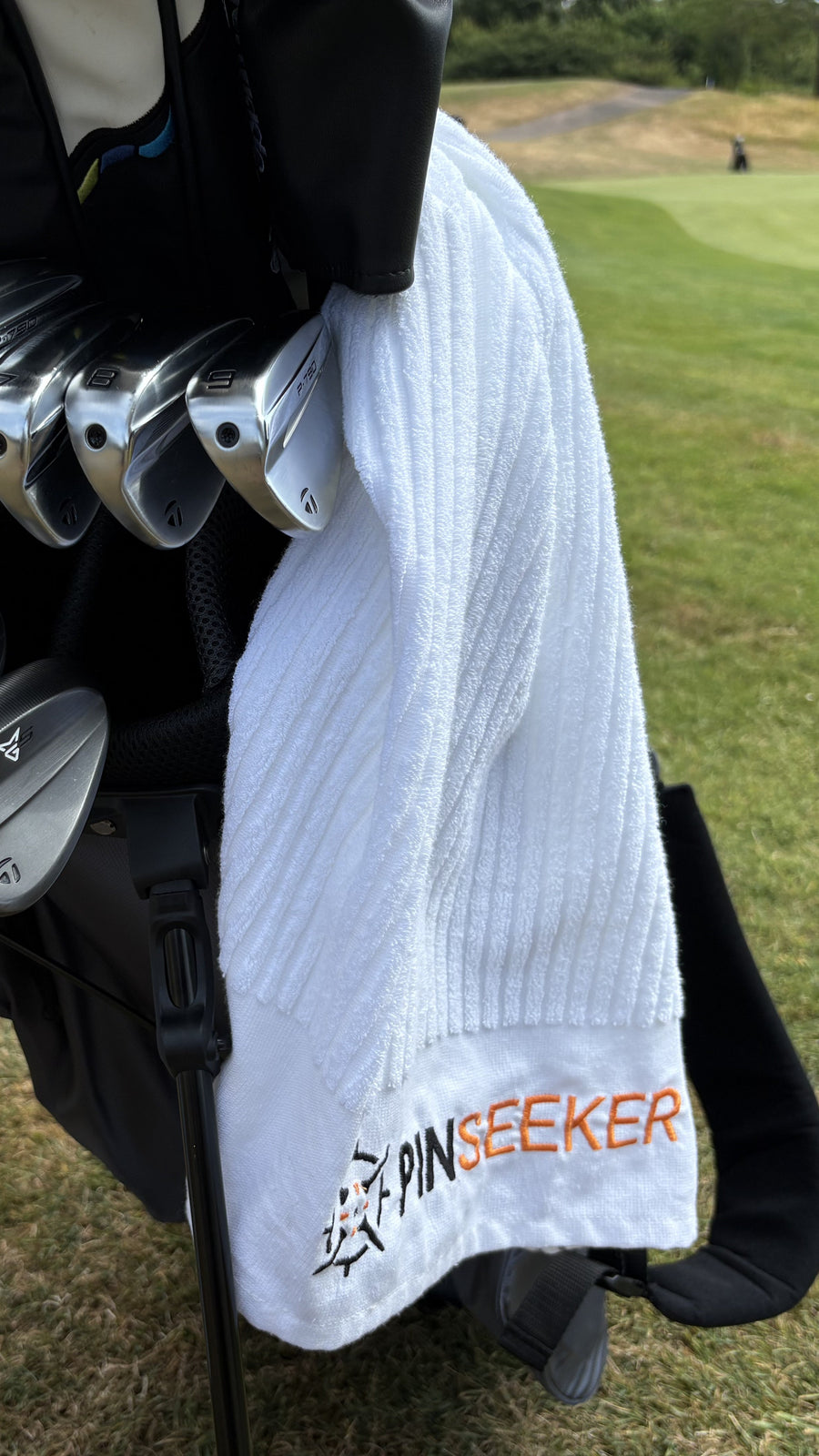
The PINSEEKER Tour Golf Towel and Magnetic Golf Towel are both 400GSM waffle microfibre. The higher GSM keeps the channels functional from the first hole to the last, while the waffle structure maintains the cleaning efficiency that flat-weave 400GSM alternatives do not match.
For a full breakdown of how GSM affects golf towel performance, including the difference between 400GSM and 550GSM cotton, see the how GSM and size work together across the range. For guidance on how to use the right wipe technique to get the most from a waffle weave towel, see how to keep your golf clubs clean on the course.
The weave does the lifting and the sequence does the rest, so the order to work in when you clean a set of clubs matters.