How to Keep Your Golf Clubs Clean on the Course
Knowing how to clean golf clubs properly between shots is one of the simplest ways to protect your ball-striking consistency. Dirt and grass compacted into the grooves of your irons and wedges rob you of backspin, turning a controlled approach shot into a flier with no grip on the green. The fix is straightforward: wipe after every shot, use the right towel, and never skip the grooves.
Why Clean Grooves Matter
The grooves on your irons and wedges are engineered to channel water and debris away from the contact point at impact, generating the friction that creates backspin. When those channels are clogged, the ball launches off a film of grass and moisture rather than engaging the groove edge directly.
Dirty grooves lose their grip on the ball, cutting spin most on wedge shots played from wet or rough lies. That is the difference between a ball that pitches and checks and one that pitches and rolls six feet past your target. On approach shots from 100 yards and in, groove condition is a variable you can control.
Dirty grooves let the ball skid off a cushion of grass and moisture instead of gripping the face. Clean grooves are not optional on scoring clubs.
What You Need on the Course
Two items handle everything:
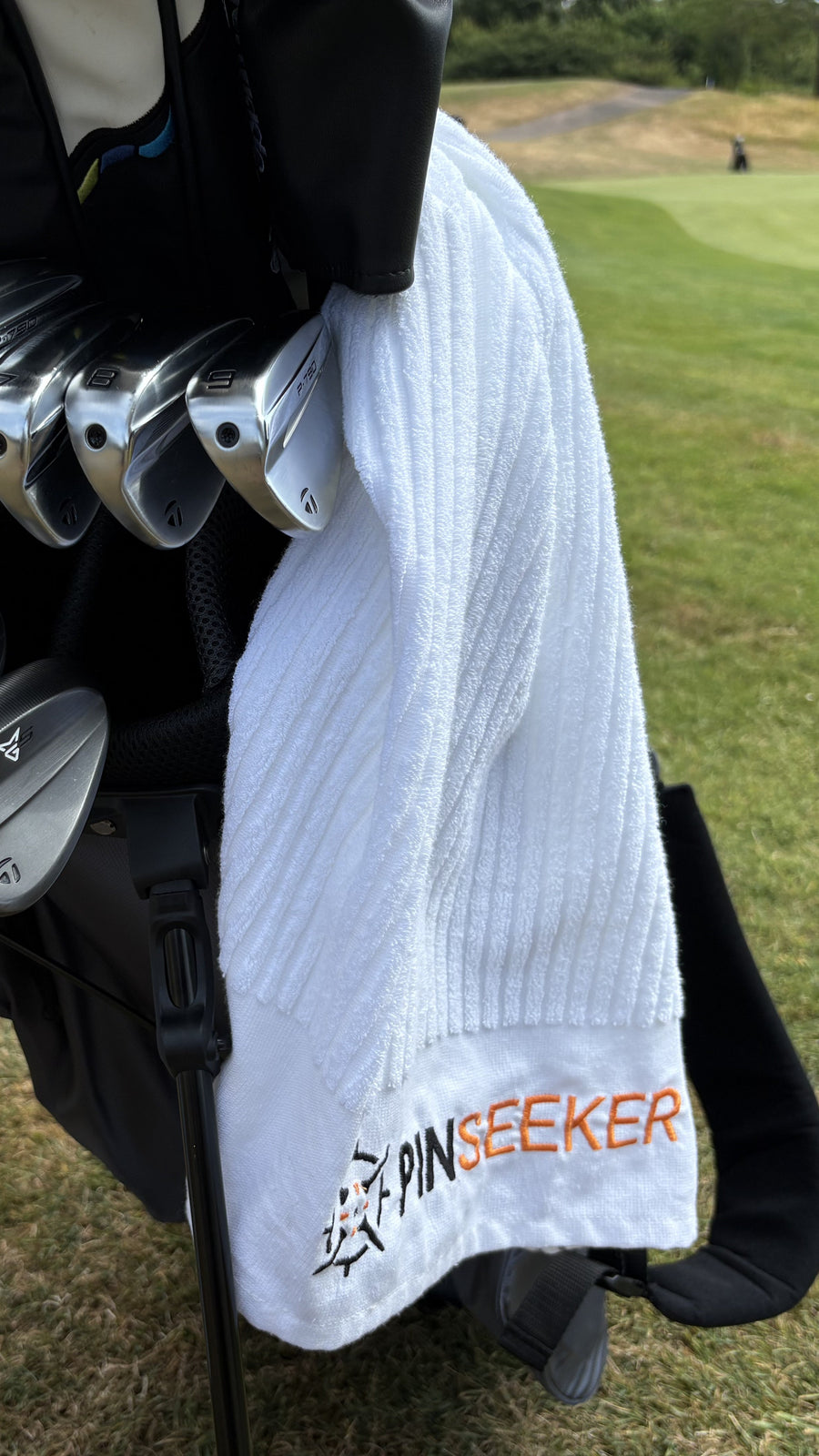
- A golf towel with a wet zone and a dry zone. You need one side damp for scrubbing, one side dry for the final wipe. A full-length towel like the PINSEEKER Tour Golf Towel (40 x 100cm) gives you a clear division between the two zones without the towel becoming fully saturated.
- A groove brush or tee. A stiff-bristled brush attached to your bag is the most efficient tool for cleaning packed grooves between shots. A tee works in a pinch, used carefully along the groove channel rather than across it.
The Between-Shot Routine
The most effective approach is to clean your club immediately after the shot, before you replace it in the bag. Mud and fresh grass debris are far easier to remove when wet.
- Wipe the clubface with the damp section of your towel, removing surface mud and grass
- If grooves are clogged, run your groove brush or tee along each groove channel in the direction of the groove, not across it
- Wipe again with the dry section of your towel to remove any remaining moisture
- Return the club to the bag with a dry face
The whole process takes under ten seconds per club. The habit matters more than the method.
Brushing along the groove direction matters because the groove edges are the functional part of the design. Brushing across the grooves repeatedly can round off sharp edges over time, reducing their ability to bite the ball at impact. A soft brass or nylon brush used in the correct direction preserves the groove geometry that the manufacturer engineered.
Irons and Wedges vs Woods and Putter
Grooves on irons and wedges are the priority. The physics of backspin generation on these clubs depends directly on groove engagement at impact, so any debris between ball and face reduces that engagement.
Woods and hybrids have shallow face texture rather than deep grooves, and their loft angles generate spin through a different mechanism. Keeping the face clean still matters for consistent contact, but the performance impact of a dirty wood face is less pronounced than a clogged iron groove.
The putter face should be wiped free of grass or mud before you read putts, particularly on approaches from the rough. A dirty putter face can deflect the ball slightly off line at impact.
Choosing the Right Towel for On-Course Cleaning
The best on-course cleaning setup combines a towel that stays accessible with one that has enough surface area to maintain distinct wet and dry sections across a full 18 holes.
Compact clip towels run out of dry surface quickly in wet conditions. A full-length centre-slit towel like the PINSEEKER Tour Golf Towel threads onto your bag and keeps 100cm of 400GSM waffle microfibre available at all times. The waffle weave lifts debris out of the groove pattern rather than just spreading it across the face.
If you prefer a magnetic attachment that drops to hand without threading, the PINSEEKER Magnetic Golf Towel uses an N52 Neodymium magnet (48kg pull force) to dock instantly to any steel surface on your bag or trolley frame. At 40 x 65cm in 400GSM waffle microfibre, it gives you enough material for dedicated wet and dry sections. For more on how magnetic attachment works in practice, see our guide on what is a magnetic golf towel.
For guidance on how to care for your towel after the round so it stays effective, see how to wash a golf towel and keep it absorbent.
Before the Round
The most time-efficient cleaning happens at home before you leave. A five-minute soak of your irons in warm water with a drop of dish soap, followed by a brush and dry-off, means you start with clean grooves. On-course maintenance then only needs to address what accumulates during the round.
Do not use wire brushes on grooves. Wire abrades the groove edges and permanently rounds them off, reducing spin performance that cannot be recovered without regrooving.
If you are deciding between a magnetic and a clip-attachment towel for on-course cleaning, see the full breakdown in magnetic golf towel vs clip golf towel: which is better. For a step-by-step guide on setting up a Tour Golf Towel on a stand bag with the correct wet and dry zones, see how to set up a tour golf towel on a stand bag.
Shop the PINSEEKER Tour Golf Towel →
For the step-by-step method and the kit list, see how to clean golf clubs.